Pin It button on image hover
Showing posts with label Chicken Farms. Show all posts

Friday, April 26, 2013

Flat Aggie Adventures in the Bluegrass State


 Flat Aggie is back and she took a friend with her to visit Kentucky.  Hold on to your hats kids, because she got some new clothes for the trip, too.   If you are new to Tales of A Kansas Farm Mom, Flat Aggie has been sent from a Kansas First Grade Class to learn about agriculture.  Here is a link to the Introduction of Flat Aggie if you want to learn more.  We are looking for hosts for next year and I welcome you to fill out my contact form if you are interested. -A Kansas Farm Mom

 Mrs. Piatt and classmates,
I’ve been very busy the past few weeks traveling to farms around the country. This week it was time for me to visit Kentucky.
I met up with Danielle Beard in Miami, Oklahoma. In order to be road trip ready, Danielle painted my nails red, handed me a pair of sunglasses, fastened my seatbelt and we were Kentucky bound!
The trip from Oklahoma was over eight hours. And let me tell you, that’s a long time to be stuck in the truck, especially with Danielle’s singing.
We arrived at Hayden Farms in western Kentucky. Hayden Farms is owned and operated by the Hayden family and specializes in growing cattle and chickens.
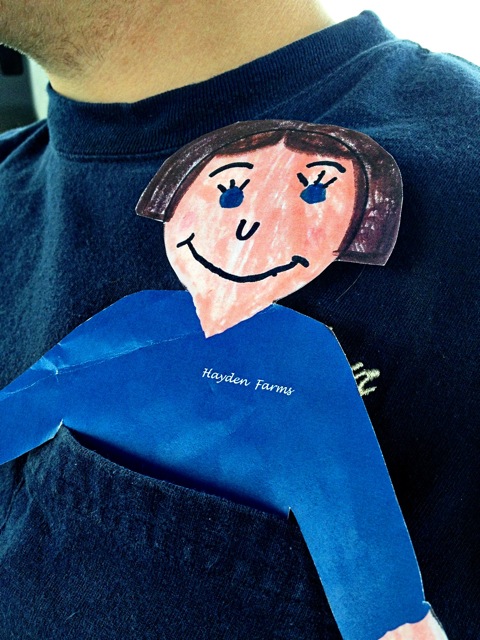
Upon arriving, we went straight to work, helping Daniel Hayden haul hay for his neighbors. Since I was there to help on the farm, the Hayden’s gave me Muck boots and my very own Hayden Farms shirt to wear. 
My first job was to help back the truck to the hay trailer. It’s not as easy as it looks, but after a few tries I got it right. 

Next, we loaded up in Daniel’s very muddy tractor and moved round hay bales from inside the barn to the hay trailer.
While I rode in Daniel’s pocket most of the time, he did let me drive the tractor once.
Later, I helped feed cows. It was fun, but the cows and their calves wanted to lick and smell me, like I was food ...and I didn’t particularly care for that.

Hayden Farms also has four chicken houses. Each house holds 25,000 birds. So that’s 100,000 chickens! The chickens are delivered when they are only an hour old, and live at Hayden Farms for six weeks until they are full grown. Then a couple of weeks after they leave, a whole new load of baby chicks is delivered.
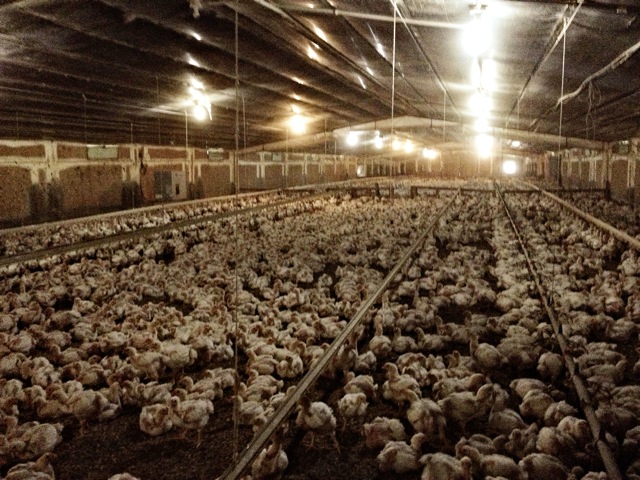
A few automatic water lines run through each house so the chickens always have access to fresh water, feed lines also run through the houses and periodically fill all the feed bowls throughout the day.
One thing I learned during my stay at Hayden Farms is chickens can be very demanding. Each chicken house is full of different types of sensors and controlled by a computer system. Anytime one of the sensors detects an unwanted change in things like temperature, water or feed, the computer will call Daniel’s cell phone and tell him which house needs him. During my stay one of the sensors quit working so ‘House 2’ called constantly. At all hours, including 4 a.m., which is when I like to sleep! 

Each time the chickens called, Daniel went to check on them, no matter what the weather was like or what time it was.

Farmers care about their animals so it’s important to them to make sure everything is always okay.

I had always thought chicken house would be smelly. However, once I was inside I didn’t notice much of a smell at all. Daniel says that is due to the industrial size fans on either ends of the houses that keep the air constantly changing.
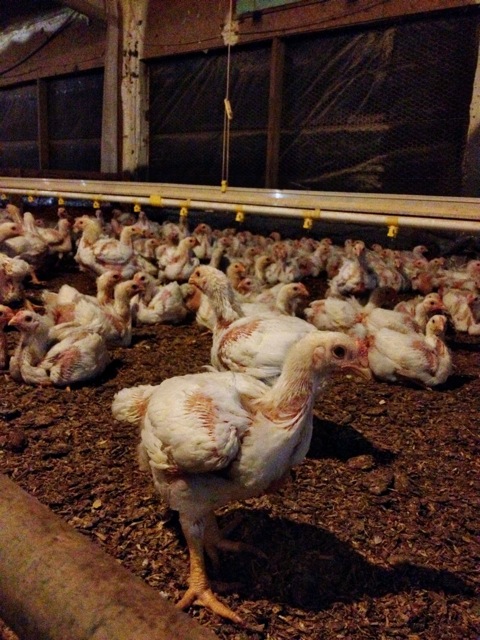
When I was in Kentucky, all the chickens were four weeks old. That means they had lost most of their baby fluff and were growing adult feathers. The way Daniel explained it is like they were in their awkward teenage years. He says in a couple of weeks they will have grown into their feet and be white and fluffy. 


When we weren’t feeding cows and checking on chickens, we all went to the coal mine. In Kentucky, coal mining is a very important part of the economy. The Hayden’s have a coal mine right behind their house! Coal is used in generating electricity, creating iron and steel, plant fertilizer, concrete and even shampoo. 


Also, in our free time, Daniel, Danielle and I went turkey hunting. We had to wear lots of camouflage because turkeys have excellent eyesight. I decided I better paint my face too, in order to be completely concealed.


Petting Duke, the Hayden’s Catahoula, was one of my favorite parts of the trip.

Duke is known as the neighborhood dog, he walks to nearby farms and homes to play with their children and grandchildren.

A big part of a successful farm is done in the office. Joan Hayden, let me sit at her desk where she keeps all the records, and does the accounting for Hayden Farms.

Sunday it was time for the drive back to Kansas, it was such an eventful week that I slept most of the trip. Kentucky was so much fun, I wish I could’ve stayed longer to learn more, but the Hayden’s said I was welcome back anytime! 

Thanks for letting Flat Aggie road trip with me to Hayden Farms! If you have any questions let me know, I’ll get them answered for y’all! -Danielle Beard

You can find me on Twitter @danibeard or my blog HighHeelsandShotgunShells.wordpress.com

For more on Hayden Farms follow Daniel @dhayden09 or David @Davidhayden7 and at farmingamerica.org.

I really owe my friends a great deal of thanks for helping with this project!  Danielle talked Daniel into this and I am very thankful.  All my friends have done a great job showing the diversity of American Agriculture.  Be sure to check back the next 2 weeks for the final reports from Flat Aggie as she visits California and Delaware.  The kids will really see diversity next week especially from the corn, wheat, and soybean Kansas they are used to seeing.


Be sure to check out Flat Aggie's other adventures in American Agriculture:

Thursday, August 16, 2012

What's your sign?


During corn harvest, I kept getting a link to an article about how farmers have always put signs near their farms and fields, but recently they have come to mean something totally different to those who have no ties to agriculture.  I read this post about why people living in Chicago think farms are owned by corporations. You can read it here.

I had never thought that a seed company sign along side a field would make someone think that the field is owned by a corporation.  This got me to thinking about what my friends, family and followers on Facebook thought when they see some of these signs.To try to get a grasp of what my Facebook Followers thought of these signs I posted this picture on my Facebook Page. (Click this link to see the comments.)


The responses were (for the most part) serious and concise and pretty much correct. I am glad my followers are so well educated on agriculture. Some were quite entertaining to my boys, especially the one about flying corn yields.  This is actually not a sign on our property, but on The Farmer's cousins.  The sign lets other farmers know what brand of corn (Dekalb), what variety (DKC 52-61), and any special traits (RIB) about the particular corn in that field.  This is simply a way for people who sell seed to advertise their products.  Farmers as a whole are a skeptical group.  They want to see a variety grown on someone else's farm before they invest a year of labor and fertilizer into a crop.  I assure you that Monsanto does not own one acre of this field.

In the whole scheme of things the above sign is not different from this sign:

We have all seen these signs around construction sites.  Most of the time these construction companies are merely providing a service to the home owner and are advertising.  The seed companies are merely advertising "aggie style" to try to gain the business of the farmer's in the area.

Occasionally, you will see a whole string of these signs along the side of a field.  This is called a test plot.  A bunch of different varieties have been planted side by side to see which one is the best.  If the farmers are lucky, there will be seeds from different companies all planted together.  Think of it as a mini competition.  The companies want to prove that their seed is the best for that particular area.

I asked for comments on one more sign on my page that did not get as many comments or as many positive comments.


This  sign is actually on one of our friends farms.  I wondered if it was the name Tyson that reduced the comments or that it was one of those "factory farms"  where birds are raised in a building that got all the negative comments. 

To clear things up:
  • This farm is owned by a family not Tyson.
  • One of our longtime friends puts in many hours working on his farm and his kids, that are about the same age as our boys, help him just as ours do.
  • Our farmer friend is what they call a "Contract Grower."  Tyson supplies the birds, delivers the feed, and harvests the birds.  Our friend is paid on how well he keeps the birds healthy and comfortable.
  • The main reason they have these signs is so the truck drivers can find the correct farms for feed deliveries, chick delivery, catch crews and live haul drivers.
  • The chickens will be sold under the umbrella of Tyson when they get to the grocery store.
My friend also wanted to add that Tyson understands that you can not hire the competitive spirit of the American Farmer, but you can include that most precious resource into your business model, and grow one of the largest food suppliers in the world.  He added there is another poultry contractor in the area that does have company owned farms as well as contract growers.  The company owned farms actually compete with its contract growers and typically do poorly compared to those who do own their farms, because you can not replace the work ethic of someone who is invested in the farms profitability.

My boys have tried to raise free range poultry the last 2 summers.  It is not as easy as it would appear.  My cows and calves do fine outside, but the predators in our area are not kind to my kids obsession with poultry.  They decided this year it was easier to keep coyotes away from their lambs than it was to keep birds alive.  To get a consistent quality product and to produce enough to feed our growing planet, we need to raise chickens and other poultry in buildings like these.  Maybe I can get my friend to give me another tour of his farm sometime so I can show you the finer points of chicken raising.  It is not as easy as one would think.

I hope this clears up a little confusion about the thought that corporate America is taking over farming.  98% of American farms are still family owned.  We buy our seed from corporations and some of our livestock is supplied by these huge companies, but it is still us, the farm families working together doing the work to keep food on your dinner table.  


I did want to add my favorite answer from the Dekalb sign picture by someone in our small town.  It brought a smile to all of our faces when we read it.  "Somebody's farming corn, making their living from working the land sun up to sun down. Long hours with no certain guarantee there will be anything to harvest come shucking time. There may be crop insurance and government subsidies, but nothing can take out the sting of all that time and effort withering away, pummeled to the ground by hail or eaten by voracious insects. That's farming and that signs says, "We're burnin' daylight! Let's get moving!" (nod to John Wayne)."  Pretty much sums up the farming way of life doesn't it.


I do have one final question :  What if the Dekalb sign had said Monsanto instead? Would it have changed the image of the sign to the non-ag community?  By the way, Dekalb is owned by Monsanto.

Do you still have questions?  Leave a comment here or on my Facebook Page.

-A Kansas Farm Mom  

I have shared this post on Deborah Jeans Dandelion House Blog for the Farmgirl Friday Blog Hop.  Go check out some other interested Farmgirls!
 http://deborahjeansdandelionhouse.blogspot.com/2012/08/farmgirl-friday-blog-hop-70.html