In an effort to make math more interesting for kids and to make my kids
understand that math really is important, I have started a
series of Farmer Math questions to go along with the Flat Aggie
reports. These are patterned after the blog Bedtime Math.
Some of the questions are easy enough for pre-schoolers and sometimes I
come up with some to even challenge high school seniors.
These questions follow the report Flat Aggie went North of the Border to learn about Eggs. Additional educational materials can be found in the post All About Eggs.
1. If there are 3 hens in each pen, how many hens are in 2 pens?
2. If a hen can lay 1 egg per day, how many eggs can she lay in 1 week?
3. Flat Aggie learned that eggs are put into trays of 30 eggs. If the tray is an array, it has 6 rows of eggs in one direction and how many rows of eggs the other direction?
4. The trays of 30 eggs are put into stacks 6 trays high. How many eggs per stack?
5. 60 stacks of eggs are put onto a pallet. How many eggs per pallet? How many dozen is that?
ANSWERS: 1.)6 hens 2.)7 eggs 3.)5 rows 4.)180 eggs 5.)10,800 eggs per pallet, 900 dozen
If you are a teacher
or homeschooler that would like more information to go with the Flat
Aggie reports, send me a message on my contact form. Along with the
report and the Farmer Math questions, we send each teacher an additional
page of activities.
-A Kansas Farm Mom

Showing posts with label Flat Aggie 2. Show all posts
Showing posts with label Flat Aggie 2. Show all posts
Wednesday, January 21, 2015

Sunday, May 18, 2014
Flat Aggie Visits Northwestern Kentucky
This is the final Flat Aggie report for this school year. I am kind of sad, but excited that at least a few of the teacher's are ready to do it again and one class wants me to talk to their teacher for next year to see if they can keep following Flat Aggie. That makes me happy that they actually like learning about farms and where their food comes from. If you are a farmer and would like to host Flat Aggie next year, send me a message. If you are a teacher who would like to use Flat Aggie in your class, send me a message, too. I would love to work with you. -KFM
Hello again Mrs. Leiker’s class! I’ve been spending lots of time in northwestern Kentucky with Daniel and Danielle Hayden! Kentucky is very different than Kansas, everything is very green and there are lots of hills.
As soon as I arrived, the Haydens’ started showing me around. Daniel manages his family’s beef and poultry farm (that means cows and chickens). Since it is spring, baby cows — which are called calves — were being born. I got to help Daniel put tags in the newborn calves ears. Farmers put tags in ears so that they can identify which baby belongs to which momma and other important information.
.jpg) Since I had already visited a cattle ranch, Daniel and Danielle taught me a lot about chickens. Hayden Farms has four poultry houses, each house holds 25,000 chickens apiece, so that’s a 100,000 chickens! One thing that surprised me was how big each house one, even though there were a lot of chickens, they still had lots of room to run around and chase each other.
Since I had already visited a cattle ranch, Daniel and Danielle taught me a lot about chickens. Hayden Farms has four poultry houses, each house holds 25,000 chickens apiece, so that’s a 100,000 chickens! One thing that surprised me was how big each house one, even though there were a lot of chickens, they still had lots of room to run around and chase each other.
.jpg) The chickens arrive at the farm right after they hatch, when they are only about 40 minutes old, they stay at the farm for six weeks until they are grown. When the chickens are babies the houses are temperature regulated to stay 94°F, but when they are full grown the houses are regulated to stay at 66°F. This is done to make sure they are always at a temperature where they are most comfortable.
The chickens arrive at the farm right after they hatch, when they are only about 40 minutes old, they stay at the farm for six weeks until they are grown. When the chickens are babies the houses are temperature regulated to stay 94°F, but when they are full grown the houses are regulated to stay at 66°F. This is done to make sure they are always at a temperature where they are most comfortable.
.jpg) After the chickens leave, Daniel and the other guys that work on the farm scrape out the floor, remove all the fans and wash them, sanitize the entire inside of each house and make any necessary repairs.
After the chickens leave, Daniel and the other guys that work on the farm scrape out the floor, remove all the fans and wash them, sanitize the entire inside of each house and make any necessary repairs.
.jpg) While I was in Kentucky I also learned that there are jobs in agriculture besides being a farmer. For example, Danielle is an agriculture writer and photographer. One morning during my time with the Haydens’ we took a three-hour drive to the opposite side of the state so Danielle could interview a family that runs a thoroughbred and Hereford cattle farm.
While I was in Kentucky I also learned that there are jobs in agriculture besides being a farmer. For example, Danielle is an agriculture writer and photographer. One morning during my time with the Haydens’ we took a three-hour drive to the opposite side of the state so Danielle could interview a family that runs a thoroughbred and Hereford cattle farm.
Thoroughbred horses are used mostly for racing. In Kentucky, horse racing is very popular. The week we visited the racehorse farm was a special week for the state, because it just so happened to be the week of the Kentucky Derby, one of the most famous horse races. The grandmother of the horse that won this year — California Chrome— lives at the farm we visited! I found out racehorses are very pampered, which is understandable since the owners of the farm said the horses ranged in price from $2,500 to $975,000. Yikes!!
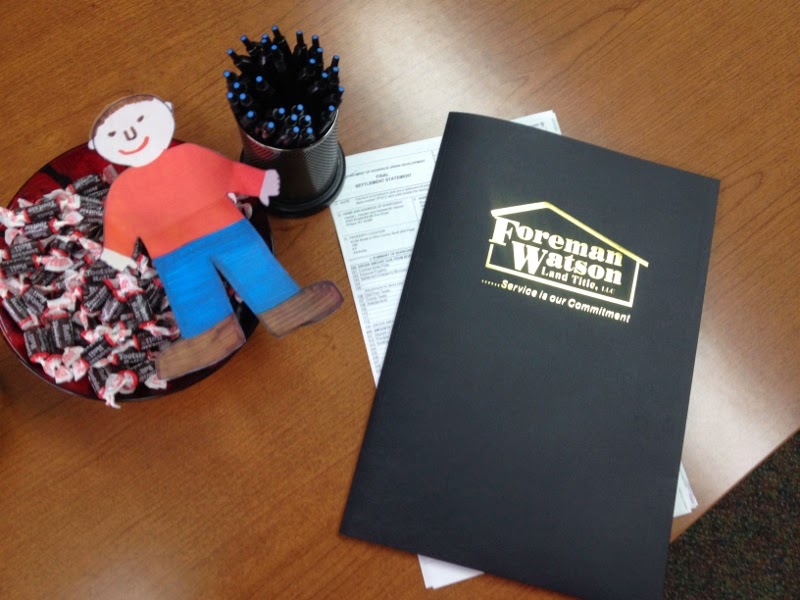
While I was in Kentucky, Daniel and Daniel were in the process of buying their first farm. Eventually someday their farm will be joined together with Daniel’s family’s farm, but for now they’re just starting out. I went with them for closing day and hung out while they signed a bunch of paperwork.
They were really excited about finally owning their own farm, but I was really excited about the humongous bowl of Tootsie Rolls!
.jpg) I was sad to leave, but excited to come back to you all and share my exciting adventure in the Bluegrass State. Someday I hope to get a chance to visit Kentucky again and learn new things about agriculture in that state.
I was sad to leave, but excited to come back to you all and share my exciting adventure in the Bluegrass State. Someday I hope to get a chance to visit Kentucky again and learn new things about agriculture in that state.
Hello again Mrs. Leiker’s class! I’ve been spending lots of time in northwestern Kentucky with Daniel and Danielle Hayden! Kentucky is very different than Kansas, everything is very green and there are lots of hills.
As soon as I arrived, the Haydens’ started showing me around. Daniel manages his family’s beef and poultry farm (that means cows and chickens). Since it is spring, baby cows — which are called calves — were being born. I got to help Daniel put tags in the newborn calves ears. Farmers put tags in ears so that they can identify which baby belongs to which momma and other important information.


 |
| California Chorme's Granddam (grandma) with this year's foal. |
While I was in Kentucky, Daniel and Daniel were in the process of buying their first farm. Eventually someday their farm will be joined together with Daniel’s family’s farm, but for now they’re just starting out. I went with them for closing day and hung out while they signed a bunch of paperwork.
They were really excited about finally owning their own farm, but I was really excited about the humongous bowl of Tootsie Rolls!
Saturday, May 17, 2014
Flat Aggie Visits Southeast Kansas
Greetings from Southeast Kansas. I visited the Small Family Farm where they grow wheat, corn, soybeans, grain sorghum and cattle. I arrived a few weeks after they had finished planting corn and I was amazed at how big the corn was considering most of the farmers in Illinois hadn't got much planted yet!

I really liked that he showed me the corn seed that the plant had grown from and it was still attached to the plant! I am pointing to it so you don't miss it.


The Small Family has lots of cows. I got to Kansas a little too late to help them give all the calves their shots. Baby calves get vaccinations just like people to help keep them from getting sick.
They were getting ready to check some cows to see if they were pregnant and I was ready to learn all about it! Sometimes veterinarians, animal doctors, reach inside and feel if there is a calf, but this week the Small's were pulling a small amount of blood from the cow to be tested in a lab.
.jpg)
.jpg)
.jpg)
.jpg)
.jpg)
.jpg)
.jpg)
.jpg)
.jpg)
.jpg)
.jpg)

I really had a good time with the Small's and they said if you had any questions, they would be happy to answer them.
Sunday, March 23, 2014
Flat Aggie Visits Central Kansas During Calving Season

Hello! My name is
Jamie Peters. I started farming and
ranching with my husband, Ryan 15 years ago.
That was when we graduated from Kansas State University. We live near Hillsboro, Kansas.
We like to grow wheat, milo, oats, alfalfa and grass on our
farm. We sell our wheat to companies
that send it on to get made into bread.
The other crops that we raise on the farm then become feed for our
cattle. Did you know cattle are
vegetarians?

Central Kansas is known mostly for growing wheat. Just to the east of us is an area called the
Flint Hills. The flint hills have an
abundance of grass and every summer the pastures there are filled with cattle
that will grow on its rich grasses. Our
cows and their babies live there during the summer.
Our weather is moderate.
In the winter it can be 0 degrees and in the summer it can be over 100
degrees. Most of the time it is
reasonably nice outdoors unless the wind is blowing hard. The wind does blow a lot here.

This morning Flat Aggie and I checked on a calf that we had
yesterday. They are in a stall because
we had to help her have her baby. There
the baby can be on clean straw and the new mommy can learn how to take care of
her first baby.

We keep track of the dad and the mom of each baby so that we
know who they are. Each cow has her own
name. In our case, they are numbers. This cow is 225. We will put a tag in her calf’s ear that has
the same number. This way, if the calf
gets lost or sick, we know whom its mother is and we can get them back
together.

Here is the calf with his tag. It doesn’t hurt them at all. It is just like getting your ears pierced.

Next, we fed my kids show steers. Charlie and Ashley left early for school this
morning so I feed their steers for them in the morning. The black one is “Fluffy” and the white one
is “Dallas”. “Houston” is shy and didn’t
want to meet Flat Aggie.

This is what they eat: corn, oats, and vitamins and
minerals. Once they have eaten their
“cereal” they will get a drink of water and then chow down on some hay. Then at night we will feed them again, just
like us eating breakfast and supper.
This winter, one of these steers will be meat in our freezer so that we
can have good food to eat for another year.
That is why we raise cattle.
Cattle are a great source of red meat, which gives us lots of good
protein so that we can grow and be healthy.

Here we are on the 4 wheeler. Sometimes we ride horses and sometimes we
ride the 4 wheeler to check on the pairs.
When a cow has a baby, her and her baby are called a pair. We check on them everyday to see that they
are growing and getting plenty of milk from their mother. Sometimes when the weather is bad, they will
get a cold just like you or I. Then we
help the feel better by giving them some medicine.

In a few months, we will give them a vaccination shot to
help protect them from diseases that will make them very sick. We also give them a brand so that everyone
knows whom the baby calf belongs to. Our
brand looks like a “puffy capital T” .
Its official name is a Box T.

When our calves grow up and don’t need their mothers milk
anymore, we will bring them home and start feeding them grain and hay, just
like the show steers you saw earlier.
Flat Aggie and I had a fun day hanging out together and
doing the chores around the farm. Just
remember one thing. We farmers and
ranchers take the best care of our animals and our crops. We eat the food we grow also.
Friday, March 21, 2014
Flat Aggie Visit the Texas Panhandle!
A big Texas howdy to Mrs. Piatt’s class from Follett, TX! Today,
I’m going to tell you about my visit to the Rafter F Ranches with my friends
Adam and Katie.

Adam and his family have ranches in Oklahoma and Texas where
they have about 500-1000 cows and calves depending on the time of year. They
also grow wheat and milo. The Ferrell's have been in the cattle business in this
area for over 100 years. The reason this area of Texas is called the panhandle
is because it sticks out from the rest of the state and looks like a handle! Let’s
see where my adventures took me!
My day started out bright and early at 5:45 a.m. as Katie
drove out to the ranch. It was so early that the moon was still out and it was
too dark for me to even see the camera!

First stop for the day was at what Adam and Katie call the
“Catesby Ranch” located in Catesby, Ok right near the Oklahoma/Texas line. It’s
important to check cattle each day, no matter rain or shine, to make sure that
they are all there and haven’t gone to visit the neighbors, and that they are
happy and healthy. During the spring, it’s extra important to check for new
calves that might have been recently born to make sure that their mommas are
taking good care of them. Adam honks the horn and that’s their signal that it’s
breakfast time.
 |
| Wait, are they all running towards me? I must be popular! |
 |
| Look, it’s a baby calf! He’s a cutie. |
Usually the cows eat mostly grass in the pasture for their
meals, but about three days a week, Adam puts out “cake” for the cows. No, this
isn’t the kind of birthday cake you are thinking about – cake is a pellet full
of extra nutrients for the cattle to help them grow big and strong. For 60 head
of cattle, Adam has to set out 14 bags of cake!


Cows also eat lots of hay, especially during the winter. It makes it easier to find their food. There's usually lots of snow on the
ground covering up their grass. We didn’t set out any hay during this trip, but we stopped by the bales
just so I could see how big they are. One bale weighs about 1,500 pounds!

My next job was to help Adam check to make sure all of the
cattle had lots of water. A cow drinks about 15 gallons of water a day. How
many total gallons of water do the 60 head of cattle at the Catsby Ranch drink
a day?
The way that cattle get their water is from windmills.
Windmills pump water from underground using wind power up to tanks on the
surface where cattle can drink it. Good thing I wasn’t scared of heights!

Next, it was time to head to Rafter F’s next ranch in
Follett, TX, which is about 5 miles away. Unlike the Catesby Ranch, the cattle
at the Follett Ranch graze on wheat from November – May. The cattle start grazing on the wheat from
when they are about 8 months old until they go to the feed yard.

The reason why the wheat is so green is because Adam irrigates
this pasture. Their irrigation sprinklers pump about 700 gallons of water per
minute to help it grow. It takes about 9 months for the wheat to fully grow.
While Adam was out at the fields, it was important that we
checked the soil profile of the pasture. I took a long stick called a soil
probe and stuck it into the ground. Good thing I have big muscles!

Once we pulled it back up, there was dirt stick in the tube.
If the dirt in the tube sticks together and is wet, that means the pasture has
enough water to help the wheat grow. If the dirt crumbles, that means it’s dry
and needs more irrigation. This dirt had a good amount of moisture – thumbs up!

Now for the best part of the day – time to drive the big red
tractor! I was a little intimidated at first since it was SO BIG, but I loved
it.

I got to help Adam disk another pasture on the ranch to help
prepare for spring wheat to be planted. Adam uses the disk to help break up the
soil to make it softer.

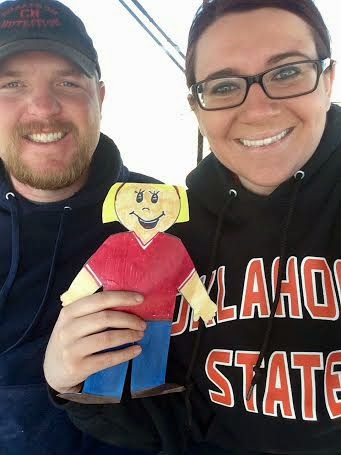
I sat on Katie’s lap most of the time, but Adam let me drive
for a little bit! I felt like a pro.

It was a long day, but I sure had fun touring the plains of
Oklahoma and Texas learning all about cattle and wheat. I can’t wait to come
back again soon! Think Adam will let me drive the tractor by myself next time?
For more adventures around Rafter F Ranches, check out Adam
on Twitter at @awferrell83 or Katie at @katie_vaz . If you have any questions,
let Mrs. Piatt know and Katie & Adam would love to answer them and give you
lots of other fun facts!
Monday, February 17, 2014
Flat Aggie on an Iowa Pig Farm
I am located in Franklin County, in North Central Iowa. I grew up by the little town of Geneva.
I now farm eight miles northeast of Iowa Falls.
I have farmed the same farm since 1973. Forty one years in the same place.
Over the years I have had sheep, cattle, horses, a goat, rabbits, different types of poultry, and of course hogs.
I am now raising corn on half of my ground and beans on the other half. In the past I have had hay, oats, and triticale. I have grown seed corn and seed beans.
The corn I grow is for hog feed. Some does get used to make ethanol. My beans make many products, but the main product is the bean meal that is used for livestock feed.
Iowa is well known for all the hogs we raise. We have an abundance of the crops to make their feed and the manure from the pigs is used to fertilize our corn and soybeans. We normally have plenty of rain to grow these crops. Our rich black soil is great at holding this moisture until the crops need the water.
I still have one old ornery horse, and lots of cats, but my livestock operation now is hogs.
I have nice buildings that are made for the pigs to be comfortable. 4,000 pigs fit into four barns where they always have the right temperature. Flat Aggie and I just refilled the barns this past couple of weeks.
Aggie did help me load the last big hogs which weighed 300 pounds. We then power washed and disinfected the barns getting them ready for the new pigs.
The new pigs weigh 50 pounds when they come in. We set the computer controllers for 80 degrees to warm up the small pigs. As they grow, we can lower the temperature to 64 degrees when they are about 150 pounds. We lower the temperature one degree at a time to keep the pigs nice and comfortable. My pigs grow two pounds per day. So they can really get big fast. They stay in my barns for four months.
The barns have heaters to keep them warm and fans and water misters to keep them cool. The sides of the barns are moveable. The "curtains" open and close to keep the temperature just right. The barns are like big sunshades in the summer time with nice cooling breezes to cool the pigs. Pigs can't sweat, so the water misters really help to keep them cool when the temperatures get really hot. Iowa summers can be over 100 degrees on some days.
In the winter, Flat Aggie can tell you that it gets very cold. It was -20 degrees with a wind chill of minus 40 degrees while he was in Iowa!
The most common food from pigs is bacon. Bacon can be added to just about any food. It's goes with eggs for breakfast, it goes on a salad, and it makes any burger better.
One of my favorite past times is smoking different roasts and ribs. Always good eating!
My blog on Flat Aggie can be found at thefieldposition.com. I guest blog there every Tuesday.

Flat Aggie’s first
day on my Iowa farm. He experienced cold weather while he was here. Temperatures
in January were not too bad, with temps reaching into the 30, but in February
they got a little colder and ranged from 24 degrees to -19 degrees. We decided
that we needed to go shopping for winter clothes.

The pigs in my hog
barns were at the right weight, 285 pounds, to go to market and we had the semis
lined up to load them. Here Flat Aggie helps me line up the chute and get the
rest of the building ready to load out.
 |
When the semi first
arrived on the hog site, Flat Aggie couldn’t wait to check out the rig!

Flat Aggie got to
meet Houdini. We named him that because he kept jumping out of the pen. When we
put him back in he was out again as soon as our backs were turned. He would
greet me at the door every day.

Hogs and kisses from
Iowa!

The pigs were not
afraid of Flat Aggie and he wasn’t scared of them even though this was his
first experience with them.

After going shopping
for some winter clothes, Flat Aggie checked the semi in the daylight.

He was so much warmer
in his new coat that he played outside in the snow while I was getting the
chute ready.

The semi driver was
nice enough to let Aggie help him load the hogs.

After the pigs were
gone, we set up the buildings so they could be power-washed in the morning. The
barns get thoroughly washed and disinfected after one set goes to market and
before the new ones move in.

Checking out Facebook
to see if Flat Aggie got any “likes”.

Checking out the
Brownfield network for the markets.

On Wednesday nights
we went to help out with classes that we have at our church for children. We
even got Flat Aggie to sing with them.


Aggie went with me to
a Farm Bureau Speaker Corps training in West Des Moines. He met some friends
of mine and had trouble sitting still during some of the meeting!

Flat Aggie was
excited to go with me to West Fork Schools for Ag in the Classroom. The kids
learned where milk comes from and used cream to make butter, which they ate on
crackers.

The kids also learned
about pigs. One of the things they had to do was to count pigs to see how many
a sow averages when she gives birth.
He even made friends
with a little girl with red hair like him.

New pigs were coming
in and we had to get the heaters set at the right temperature.

The pigs were sure
friendly. They were trying to figure out just who Flat Aggie was.

One even had red hair
just like him!

We had a good time
working together!

Sometimes we have to
haul corn.

We use a moisture tester to check the corn and then use an auger to
load it on to a wagon or a semi to bring it to an elevator.

We talked about
grain bin and auger safety.
The grain bin holds the corn and an auger moves it
to the wagons.

We moved snow and got a chance to play in it one more time!

Aggie got the chance
to meet another assignment that he may have. She is from Hawaii. He’s excited
to learn about agriculture there. He knows he’ll be in a lot warmer climate and
got some new clothes for the trip.

Here we are on the
last day of Flat Aggie’s visit on an Iowa farm. We are discussing the fun we
had, and he says he has learned a lot. I told him he could visit any time and I
hope it has helped to teach your class about agriculture and its importance to
everyone!
Thanks for including
me in your project and if you have any questions please feel free to ask!
I am always amazed when the Flat Aggie reports come back each month. I really think they get better each month! Be sure to check out the other Flat Aggie reports and Pig Farmer Math. -A Kansas Farm Mom
Subscribe to:
Posts (Atom)