Pin It button on image hover
Showing posts with label Corn. Show all posts

Wednesday, May 8, 2019

DYK Cows Can Upcycle?

Dexter is back this week with a new round of Did You Know with some Beef Month facts for you.  When I was in school they called it recycling, but now the cooler term is up-cycling trash into something more valuable.  -A Kansas Farm Mom

Did you know May is Beef Month?  For the beginning of the month I want to share why I like to think about how cows are the ultimate up-cyclers. 

Did you know that cows eat the corn leftovers from ethanol production called dried distillers grains that is high in protein? They can also eat the leftovers from beer and whiskey production called brewers dried grains. 


Soybean meal is the most widely used protein source in livestock feeds. Did you know most vegetable oil is soybean oil? I guess you can say that soybean meal is the leftovers from our fried food fascination.

Everyone likes to wear cotton t-shirts and a good pair of blue jeans. Cows like the leftovers of that too! The seed has to be removed from the cotton fiber. The seed is then pressed for the oil. The leftovers are made into cottonseed hulls and cottonseed meal for cows. The meal is high in protein and the cottonseed hulls can be fed for fiber or we can even feed the whole seed (mainly to dairy cows).  We feed several pounds of cottonseed hulls to our show heifers. Dairy farmers even feed while cottonseed for protein and energy.  Check out this post called Trash to Nutritional Treasure from the Arizona Beef Blog for more information.


Beet pulp can be fed to cows, too. Beet pulp is the leftovers of making sugar from sugar beets. Our heifers can eat beet pulp for fiber. The cows enjoy are sugar addiction, too.

Not only do they eat of our leftovers, but 85% of the ground that cows graze is not suitable for crop production. My friend Dairy Carrie has a great post on what they feed their dairy cows and links to other farms and ranches who share their upcycled feed even from oranges.  For even more information about Bovine Upcycling with lots of great statistics check out this post from Cow Country Blog.

Cows truly keep the earth cleaner for all of us and produce high quality protein that we can all enjoy. We have enjoyed this new casserole mom found this winter. 

Beefy Cheesy Cornbread Casserole

1 pound ground beef
½ cup chopped onion
Salt and pepper
1 teaspoon garlic powder
1 (8.5 oz) Jiffy Cornbread mix
1 egg
1 can cream style corn
2 cups Monterey Jack or Cheddar Cheese

Preheat oven to 350*F.  Butter the bottom and sides of 8x8 casserole dish.

Brown and drain beef and onion.  Add seasoning and stir well.  In a small bowl, combine cornbread mix, egg, milk and corn.  Stir well.  Pour half of cornbread mixture into dish.  Add beef and onion and spread evenly.  Add cheese and remaining cornbread mixture.  Bake 35-40 minutes.

 For more posts written by Dexter, check out the Mad Cattle Co. tab on this page.

Sunday, February 24, 2019

Dexter's Did You Know? Genetics


About a month ago, I made an infographic on my Facebook page, MAD Cattle Company, stating that U.S. cattle producers produce 20 percent of the world’s beef with only seven percent of the world’s cattle. My first blog post also talked about this topic.
 

The next day in discussion with my biology teacher, we began to wonder how this could be and how our operations could help make the percent of beef produced by the U.S. even higher.  We came up with only one answer.  Genetics.  We can control what genetics our herds include.  We also looked at what types of cattle third world countries are raising and found that they are still picking for survivability and work while the US ranchers usually select from growth or carcass traits to improve your eating experience and to keep costs low for the consumer.


Next, we looked at how our own operations could influence the U.S. gene pool.  Now, some of you might be wondering how genetics from two extremely small operations could influence something so large.  Our answer would be simply to improve our cattle and help provide extremely good replacements to grow the U.S. beef supply.  

Did you know that genetic improvement in one herd is going to eventually affect everyone who buys cattle from them either for slaughter or replacements?  Genetics tend to spread like wildfire especially if they work.  Through artificial insemination, smaller producers can affect even those who buy their cattle for replacements and beyond.  


I assumed the U.S. cattle industry is emphasizing the importance of genetic improvement and selection.  How many more percent of the total beef supply could we control if more people improved their genetic bases and stopped buying and keeping the cheapest animals at the sale barn?  I was surprised at how few people utilized genetic technology such as A.I. (Artificial Insemination) to improve their herd’s genetics. I investigated how few people looked at Expected Progeny Differences (a selection tool that predicts how well an animal could perform) as a serious factor in bull selection and found not many do.  I have begun to wonder how much higher the U.S.’s beef supply would be if individual herds started using the technology already at their fingertips.

U.S. feedlots tend to use more specialized personnel than other countries such as nutritionists who formulate balanced rations based on what is locally available as well as supplements to improve feed efficiency.  I plan to talk more about feeds next time.-  Dexter


Enchilada Lasagna


1/2 cup onion
2 tablespoons butter
2 pounds lean ground beef
2 tablespoons flour
3 tablespoons chili powder
1 cup water
1 (10 oz) can tomato soup
2 cups shredded cheddar cheese
1.5 cups light cream
1/2 cup chopped onion
1 teaspoon salt
12 corn tortillas

Saute 1/2 cup onion in butter in skillet.  Add ground beef.  Cook until brown and crumbly.  Stir in flour and chili powder.  Cook five minutes longer.  Add water. Cook until thickened stirring constantly.  Combine soup, cheese, cream, 1/2 cup onion and salt in bowl; mix well.  Slice tortillas into strips.  Layer tortillas, ground beef mixture and soup mixture 1/2 at a time in buttered 9x13 baking dish.  Bake at 325*F for 30 minutes.  Yield:12 servings.

Dexter is my oldest son and is working on a new 4-H project this year.  He is a 16 year old sophomore in high school.  He talks about cattle way too much, enjoys wrestling, likes to eat A LOT and I am making him cook, too.  He is involved in 4-H, FFA, as well as the church and school choirs.  He manages a Facebook page called MAD Cattle Company (Maddix & Dexter...because I wouldn't let them name it DAM Cattle Company ;) )

Tuesday, January 22, 2019

Flat Aggie visits Lorenz Farms in Nebraska

January 2019


In January Flat Aggie visited the Lorenz Farms near Broken Bow, Nebraska which is
owned by myself (Bobbi) and my husband Mark.  We have a son named Isaak who
will turn 6 years old in February. He is in Kindergarten at SEM (Sumner Eddyville,
Miller) School located the small town of Sumner, Nebraska.  His school is 3 towns
combined and is Pre-Kindergarten through High School (12th grade) all in 1 large
building.   

Our farm grows corn and hay, which we feed to cattle we raise and custom care of
for a feedlot.  We own about 100 head of cows which we raise calves to sell to a
feedlot and we work for a large feedlot that is about 20 miles away from us taking
care of some of their calves.  The feedlot uses smaller farmers like us to grow
young calves (called feeder calves) to prepare them to spend 4-6 months in the
big feedlot before they are harvested into high quality, nutritious beef.  We can hold
three semi loads of calves, which transport 70-100 calves each depending on how
big the calves are. Right now, we have 267 head of feeder calves in three different
pens from the feedlot. Calves will come to us weighing between 500 and 700
pounds.  They will gain approximately 300 pounds while they are here for 70-100
days. Our job is to vaccinate them when they arrive, get them use to eating fresh
feed daily from a bunk, and monitor their health daily.

Flat Aggie had get up early in the morning so she could ride along with Mark while
he did the morning chores and fed all the cattle.  She got to help Mark load the feed
ingredients into our feed wagon which mixes all the ingredients into a balanced diet
containing all the nutrients they need to grow and stay healthy.  We feed a mixture of
hay, corn, wet distillers grain (co-product from the ethanol industry), and a mixture of
vitamins and minerals. Mark and Aggie checked each of the groups of calves to
make sure every one looked healthy and came to the bunk to get their breakfast.  

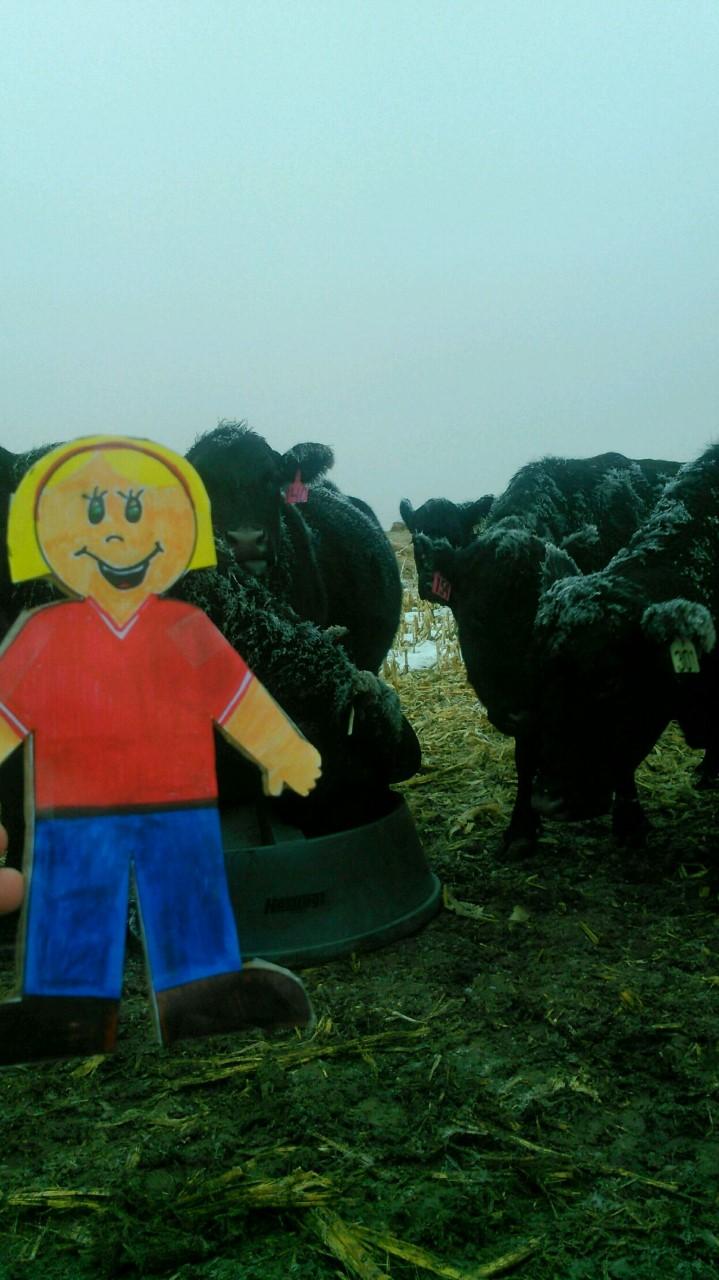
This time of year our cows are grazing corn fields.  They eat the left over corn plants
after the grain has been harvested in the fall.  After Aggie and Mark got done feeding
the calvesthey drove to the field to check the cows.  They made sure the water tank
was full and free of ice, checked the salt and mineral feeder to make sure it was not
empty and drove around the cows to make sure they were all healthy and getting
enough feed.  Our cows will begin calving (having their babies) around March 1st. We
will bring them all back to the fields and pastures around our house and barns in mid
February so we can check them and their new calves every 2-3 hours through out
the day and night.  

We brought the first calf heifers (2 year old cows that will have their 1st baby this
year) home the 1st of January.  They are scheduled to start calving Feb 4th.  They
have their babies earlier than the cows so that we can keep an even closer eye on
them to make sure both the heifer and new born calves are healthy and the new
mommies learn how to be good moms.  We keep the heifers in a small pen by the
barn where we can keep them out of the winter weather better and have good
lighting to see what is happening at night. Every night when we do our 10 pm check
we put the heifers in the barn for better protection from the colder night time
temperatures.  We use technology to help us monitor the birthing process without
having to make the heifer nervous with us being out in the pen or barn all the time.
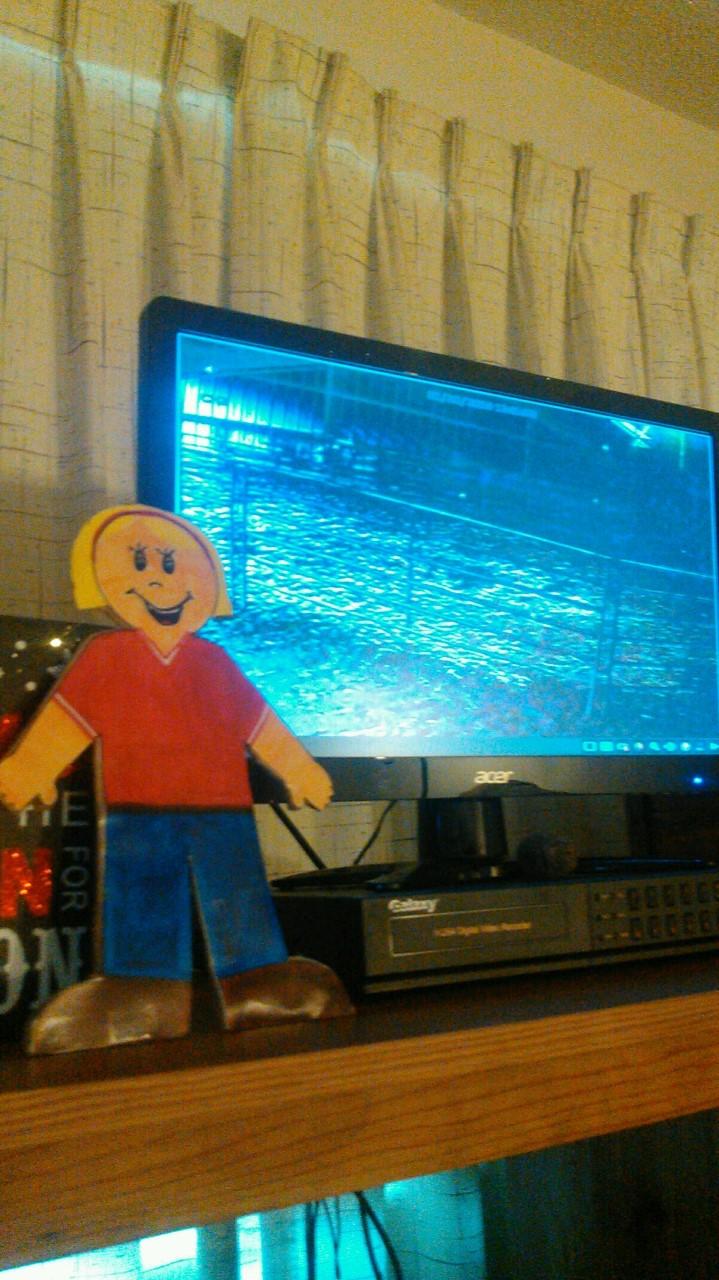
We have cameras installed in the barn that are wirelessly connected to a computer
screen in our living room. These cameras allow us to see what is happening out in
the barn without disturbing the heifers.  We still walkthrough the heifers every 2
hours but we use the camera to help monitor between checks. We were hoping
Aggie would get to see a new calf before she headed out for her next adventure but
the heifers did not cooperate to give her the opportunity to see a new born.
We enjoyed showing Flat Aggie around our farm and sharing with her how we raise
beef.  


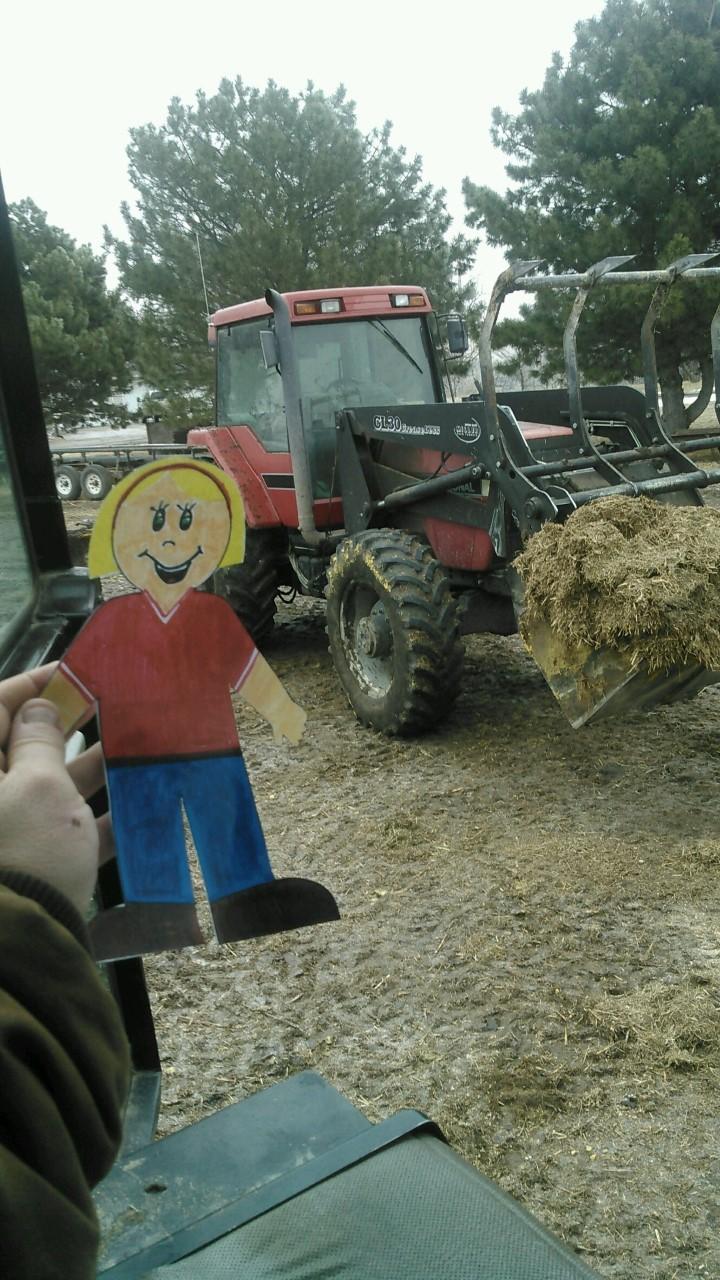
D:\Flat Aggie- loading feed.jpg


Riding along while loading the feed in the feed wagon to mix.  The loader bucket
has ground hay in it.

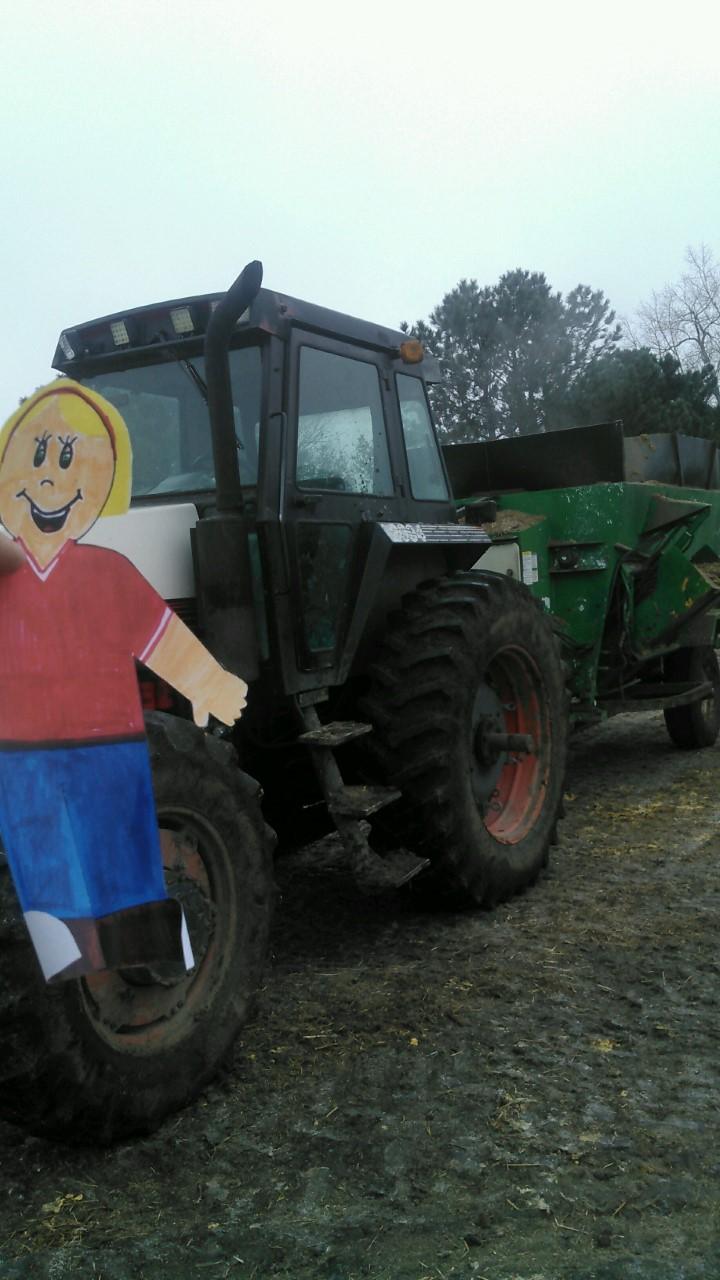
D:\Flat Aggie - feed wagon.jpg


Tractor and feed wagon are loaded, feed is mixed together, and ready to deliver
it to the calves.  
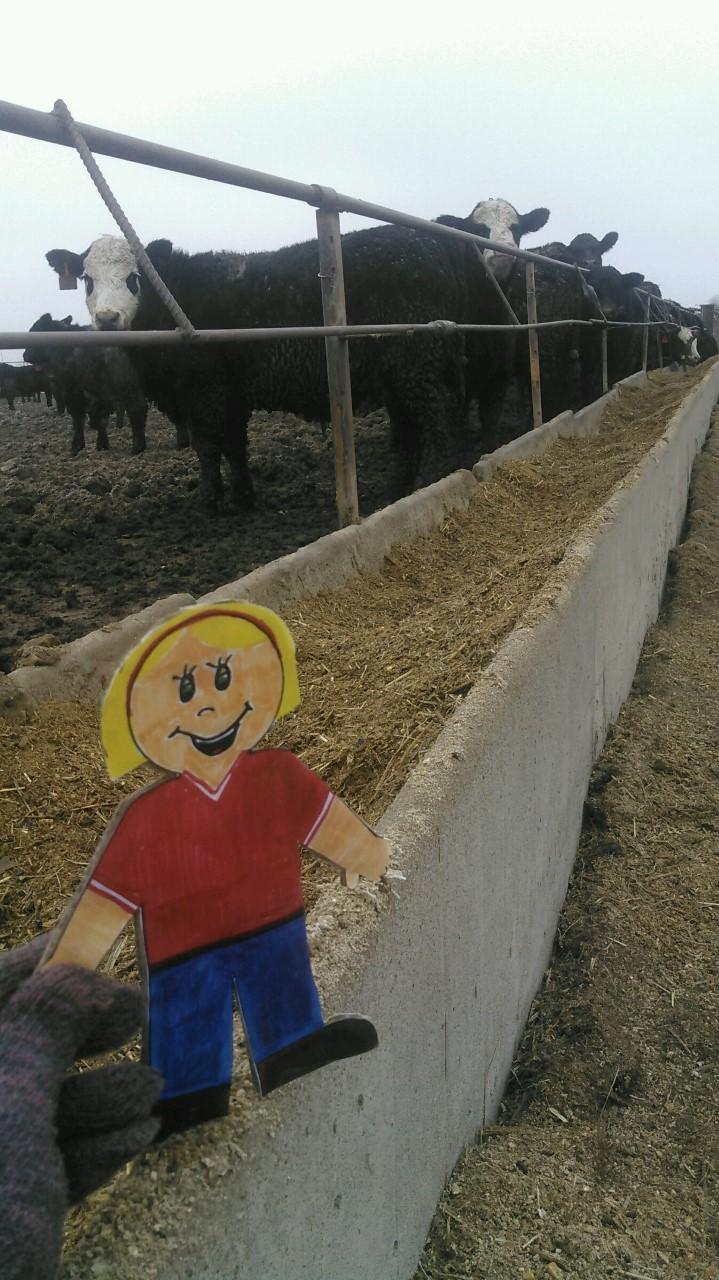
D:\Flat Aggie - bunk.jpg
Feed has been delivered to the calves.  They were not very sure about getting their
picture taken.  These calves weighed 585 pounds when they arrived around and
will be leaving in the next week or two.
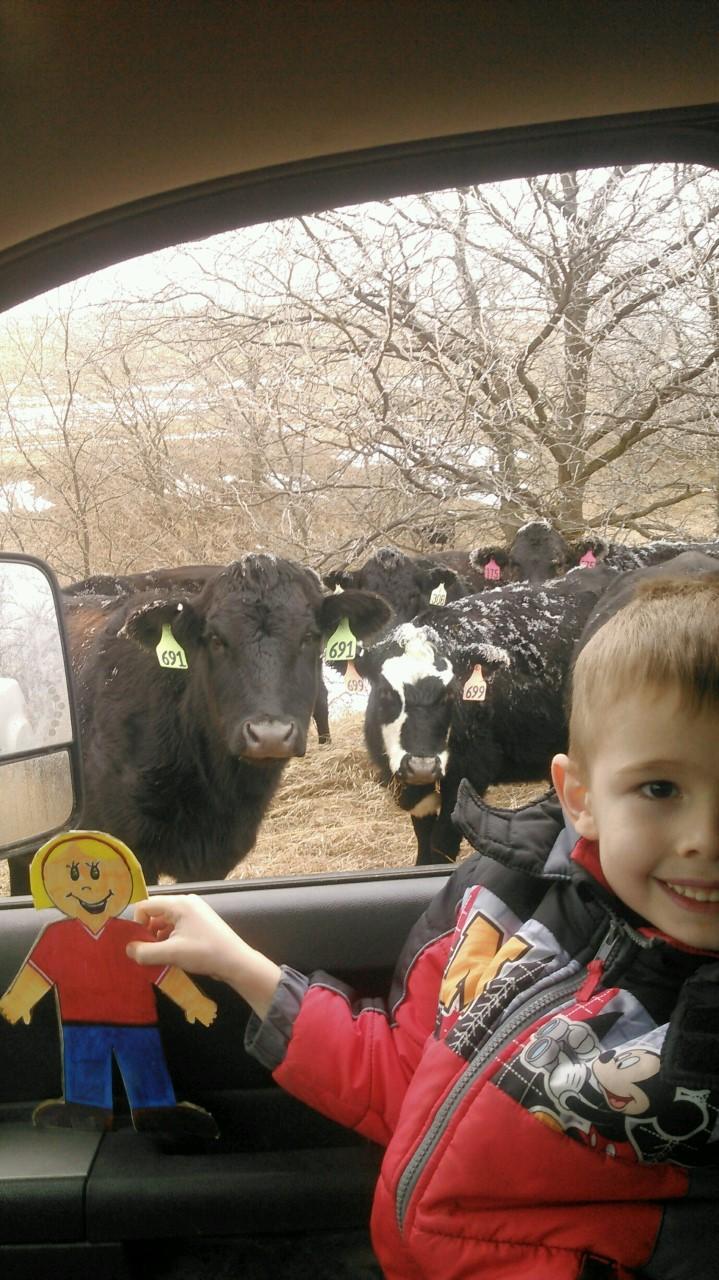
D:\Flat Aggie checking cows.jpg
Mark, Isaak and Aggie checking the cows.  The cow with the green ear tags
#691 is one of Isaak’s cows.  We use a numbering system on our cows. The
1st number is the last number in the year that they were born, #691 was born
in 2016, this spring she will turn 3 years old.  The last two numbers are their
unique ID number. Every cow has her own number.

D:\Flat Aggie Putting out mineral.jpg
Filling the mineral feeder with salt and mineral.  The cows will lift the lid on the
feeders with their heads and lick the mineral and salt.  It was a pretty cold and
frosty day and the cows had some frost on their backs. It is actually a good sign
when there is snow or frost on the cows.  Cows with plenty of insulation (good
clean fluffy hair, and plenty of fat under their skin) stay warm on the inside even
though they may look cold on the outside.
D:\Flat Aggie - barn camera.jpg

This is the computer screen that shows the barn cameras.  We have two cameras
set up so we can see 2 different pens that are in the barn.  The heifers are moved
into the barn at night so we can keep a closer eye on them as well as keep them in
where it is warmer during these cold winter days.  During the day they are out in a
pen in front of the barn but they have the option to come in
if the weather is really bad. 

For additional class resources we recommend visiting: Beef Farmer Math and All About Beef.

Wednesday, November 11, 2015

Farmer Math-Cattle and Corn

In an effort to make math more interesting for kids and to make my kids understand that math really is important, I have started a series of Farmer Math questions to go along with the Flat Aggie reports.  These are patterned after the blog Bedtime Math.  Some of the questions are easy enough for pre-schoolers and sometimes I come up with some to even challenge high school seniors.

These questions follow the report Flat Aggie visits the Maricle Family.

1.)  Flat Aggie helped load 3 semi trailers with cows and 1 trailer with calves.  How many semi trailers did Flat Aggie help load in all?

2.) Flat Aggie helped moved the cows and calves home in semi-trucks 75 miles.  If the trucks average 50 miles per hour, how long did it take for the cattle to arrive back home?

3.)  Cows can eat 3% of their body weight each day.  If the cows weigh 1200 pounds, how many pounds of feed can a cow eat in 24 hours?

4.)  Flat Aggie helped pick corn in a field that measured 1500 feet by 3600 feet.  How many acres did Flat Aggie help harvest?  (an acre is 43,560 square feet)

5.)  In the above field, Flat Aggie harvested 31,488 bushels of corn.  What is the average yield in bushels per acre for the field?  (Round to the nearest whole number)

1.) 4 trailers  2.)  1.5 hours  3.)  36 pounds  4.) 123.97 acres  5.)  254 bushels per acre

If you are a teacher or homeschooler that would like more information to go with the Flat Aggie reports, send me a message on my contact form.  Along with the report and the Farmer Math questions, we send each teacher an additional page of activities, crossword puzzles and sometimes a few hands on activities.

You might also like: Cow and Soybean Farmer Math, Cattle Farmer Math, and Corn and Soybean Farmer Math.

-A Kansas Farm Mom

Tuesday, March 24, 2015

How Much Science is Around Me?

While at Commodity Classic 2015, there were lots of opportunities to learn from others in the farming business.  I was very excited to sit in on a session sponsored by the Ohio Corn and Soybean Farmers where they have been working to help 60 high school teachers understand more about farming.

While teachers are intellectually curious, 

science teachers are admittedly 5 years behind what is going on with research.  

 Ohio corn and soybean farmers have asked the question:

"How do we help them catch up?"

While there are many educational sites on the internet for science lessons, the teachers insist that the best part of the program in Ohio was the summer session with lots of educational ideas AND time with real life farmers.  Teachers get to ask all kinds of questions of the farmers, industry professionals and university scientists.  These discussions and conversations leave the teachers with resources (farmers) they can call on when they need help.

I loved seeing these teachers in the trade show.  How did I know who they were?  They were the ones wearing the tie dyed lab coats everywhere they went.  They were also asking the tough questions about biotechnology in all the technology company booths.

 Online Resources

There are some great curriculum ideas on the site Ohio Corn Education like the stream sampling activity that we did.  Not only do the students analyze whether the stream is in good shape or not, but they also brainstorm for reasons why it is in the condition it is and how to improve it. The following are categories found for curriculum on their site.
  • Biotechnology
  • Energy and Ethanol
  • Feeding the World
  • Growing Ohio
  • Soil and Sustainability
  • Water Quality

There are even more curriculum ideas on the page GrowNextGen.  On this site, the lessons are broke down into the following groups:
  • Agriscience
  • Biology/Biotech 
  • Chemistry
  • Informal Education
  • Environmental Science
  • Career Videos
  • eLearning Courses

The Coolest Teaching Idea?

I thought the most innovative idea I heard about was the science teacher that cleared a parcel of land close to the school, so the kids could grow their own corn test plot.  The students had to harvest by hand, count the number of rows and seeds per row to estimate yield.  They learned what husking and shucking and shelling meant.  What the teacher did next was what took this idea to the next level.  The students took the corn into the lab and produced ethanol with the corn that they had raised.  How cool is that?!?!

The best quote I heard from this program was, we are:

"Giving the message of good science, so they are smarter with their decisions and not followers of the messengers of bad information."

The 60 science teachers that are participating in the program are impacting 12,120 students per year.

How can you help a science teacher in your local school? 
Do they need someone to ask questions of?

-A Kansas Farm Mom

Sunday, September 14, 2014

The Little Farmer in the Making's Corn Harvest

We knew when we started the Little Farmer's corn field way back in April that we would have to harvest on the weekend.  There was no way that he was going to miss the combine going through the field.


Before we could go to the field, we had to do a little maintenance on the combine.  The windows were really dirty, so he helped Grandpa Art.

No, we didn't need to use the leaf blower on leaves, but it works really good on...
the air filter for the combine.  It was pretty dirty and yes it is a little bigger than the one in your car.
Finally, ready to go to the field!!!!!!
My absolute favorite picture of the entire corn harvest!  Watching the crop go into the wagon.

And we were all done.  Next, we will plant wheat in this field and let the cows eat the wheat and the left over corn stalks.
I hope you have enjoyed following this corn crop as much as our family has.  It has certainly been fun to watch the crop grow through an 8 year old's eyes rather than my old eyes.  The grain was hauled to the bins on our farm, because the elevator in town was clear full.  You might check out the post This Little Grain Went to Market to know where the corn will be used.

Stay tuned for another crop to follow with our 11 year old son.  He has plans and he has seed!

-A Kansas Farm Mom