Pin It button on image hover
Showing posts with label Drought 2012. Show all posts

Monday, December 24, 2012

'Twas the Morning Before Christmas

"Twas the morning before Christmas and all through the house not a creature was stirring...not even MOM!!!

Where was she?!  Shouldn't she be wrapping asked the youngest son?!
Shouldn't she be baking and singing Christmas songs worried the oldest son?!


The weatherman says there's going to be cold weather and possibly snow,
Grain is a source of extra energy for the cows.  Keeping warm on cold days takes lots of extra energy.

so the Kansas Farm Mom and her farmer hubby were out unwrapping hay bales for their girls to keep their tummies full and their bodies warm.
Taking the net wrap off a bale wearing a stocking hat that my Grandma made me before she died. :)

The kids will understand if not everything gets wrapped or baked (even the Cinnamon Roll Muffins).  The cows come first on this ranch.

White Christmas' usually aren't welcome in this part of the land.
Snow makes more chores and leaves less time to spend with the family on Christ's Birthday.

The continuing drought reminds us all that each drop of moisture from the heaven
 is a gift from God.  We thank him for each flake he sends us tomorrow on Christmas mornin'.

Merry Christmas everyone!!


P.S.  If you are new to my blog, follow me on Facebook or follow the link at the top to be notified each time I have a new post.

-A Kansas Farm Mom

Linked to:
 Farmgirl Friday Blog Hop

Sunday, October 14, 2012

Kansas Wheat Planting

 October in Kansas means it is time to plant wheat.  Before winter?  You might ask.  A farmers response would be yes!  In Kansas, we plant what is called Hard Red Winter Wheat.  It will start to grow this fall and when it gets cold it will go “dormant.”  If it gets REALLY cold, we hope that there is snow on top of the wheat to protect it from extreme temperatures. 


If you follow me on Facebook, you know that I spent several days spreading fertilizer on the ground that was going to be planted to wheat.  Scientists know how much nitrogen, potassium and phosphorus is removed from a field for each bushel of grain we raise.  We apply fertilizer to replace those nutrients.  It looks quite a bit like the slow release granules you can buy for your flower beds at home.  We also take soil samples periodically to make sure we are not over or under applying the plant food to the crops.

Our local supplier delivered fertilizer to the field for me.

I used a fertilizer spreader pulled behind the tractor.  When you look at it, it looks a lot like the lawn and garden spreaders you might use in your yard; however, where you “eye ball” where you should walk next, I on the other hand have GPS that keeps me within 6 inches of where I need to be to apply accurately.  I was driving every 50 feet by the way. 

My GPS unit that helps me drive straight and the same distance from each and every pass.
The Farmer went out to plant the wheat after I was finished delivering the nutrients to the fields.  Each part of the country has a preferred planting date.  In our part of Kansas, the Hessian fly free date is October 15 (which happens to be very close to our average first frost date).  If your wheat is up and growing before that date and the Hessian flies are present they can cause problems next spring in the presence of disease.  We started a little early knowing that we were forecast to get a freeze the first weekend of October.  Since we are still in a drought, we also needed to plant while there was still moisture in the soil and possibly a chance of rain. 

It may look like there are a lot of weeds in the field, but after the freeze we had they are all dead.  We prefer to use mother nature to control weeds this time of year instead of chemicals.

As I have said before, we are no-till farmers.  We don’t till or “work” the ground before we plant.  It has greatly reduced how much fuel we use and leaving the residue from the previous crop provides a great mulch to the growing crop.  This was very well utilized this past summer with the extreme heat and lack of rainfall.

These corn plants died after the frost and will leave a nice layer of mulch to help hold in moisture this winter.

In a week or so, we will see the wheat growing in the rows, it will just look like grass from now until April.  The heads will start to develop and emerge closer to summer and it would look like the wheat you know and have seen in pictures.

One of our wheat fields last April after the heads had emerged.
We typically harvest our wheat in the middle of June; however, this year we were harvesting in May.  It has been such an unusual year.  Have you seen where my crop goes after harvest?

Curious when farmers plant and harvest the different crops?  Each part of the state is different and although this isn't perfectly our Southeast Kansas calendar it is a good post on In Between the Sunsets of Life.

What are you doing in your gardens and fields in preparation for winter?

Sunday, September 16, 2012

Weaned Calves Update

I was talking to one of my friends in Minnesota the other day and she asked how the calves were doing that we had to wean early due to the drought.  I guess I left everyone hanging on their progress after this post.

This year we did 2 types of weaning depending on where the calves were and who their moms were.  The calves that were in pastures that did not have good fences were brought to the headquarters and weaned in the lot.  The calves of the older cows were also brought home.  We have found when we take their calves away a 5 strand barbed wire fence means nothing to them if they want to get to their calf.

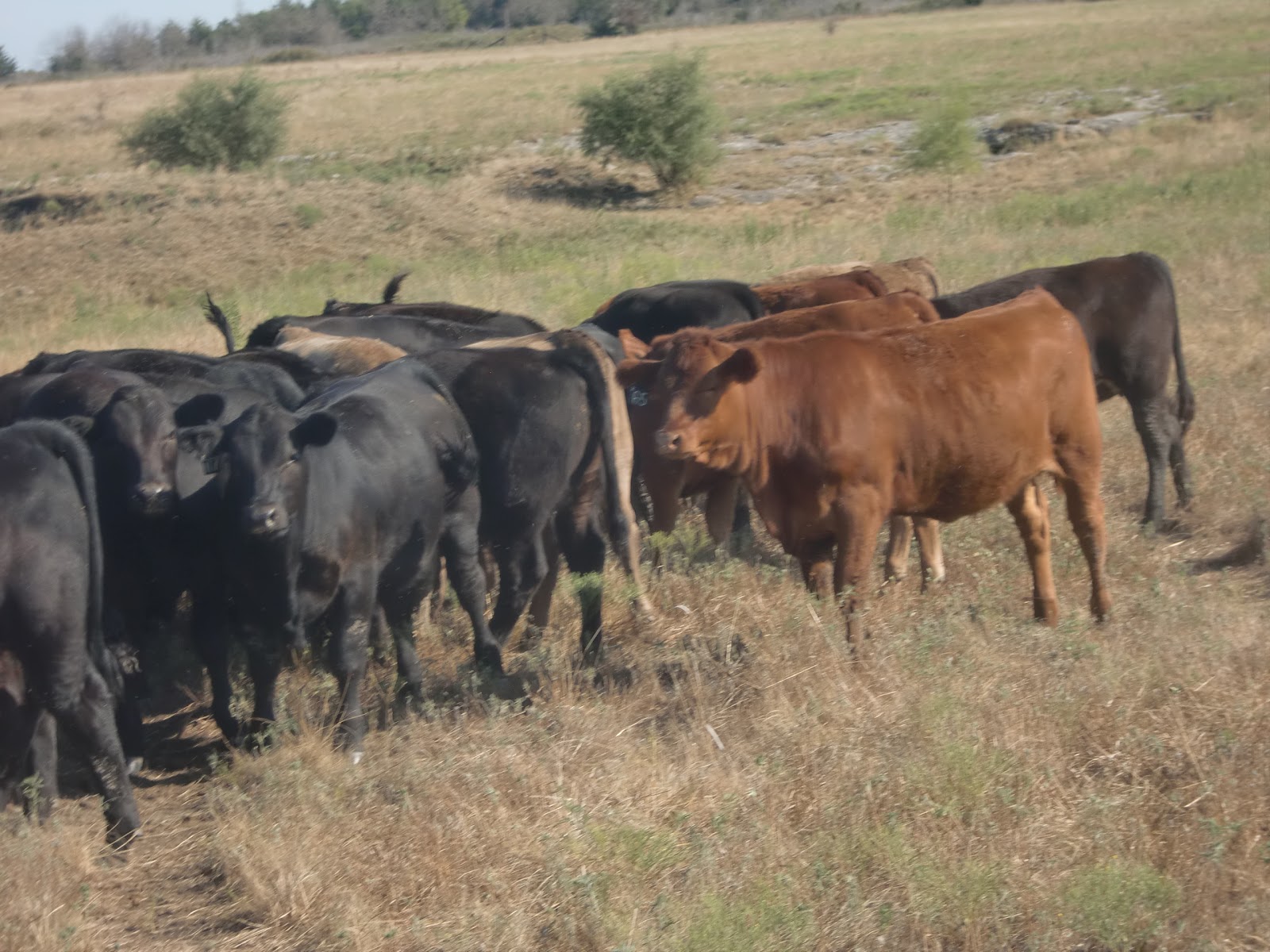
These calves are eating grain on the ground just 20 feet from their mothers on the other side of the fence.  The drought has made all the calves want to try something new to eat.


The last few years we have been trying to do a larger amount of Fence Line Weaning.
  • You must have a very, very good fence.  At least our cows didn't want to stay on the other side of the fence from their calves when we tried to do it in a pasture less than perfect fencing.
  • It allows the calves to stay in the same pasture, they know where the water is and where the good grass is located.
  • It allows them to stay in contact with their moms.  In fact, we caught several still nursing through the fence.
  • It is kind of like sending your kids to Kindergarten at a local school instead of sending them to a boarding school.
Everyone got a second round of vaccinations recently to help keep them protected from diseases.  The grass is getting shorter and the ponds are getting lower, so we are trying to keep them gaining weight as efficiently as we can so we implanted the steer calves with growth implants.

We sorted the steers and heifers.  We will keep them separated from here on out. The Farmer tries to bring one sex or the other to me and if I am lucky he will tell me which way to swing the gate before the calves get to me.  It was my job to swing the gate accordingly.  I have a video I shot with my phone, but I am having technical difficulties tonight.  Maybe tomorrow I will get it fixed and uploaded.

These calves decided the feed truck was their friend and followed it anywhere it went in the pasture.

The early weaned calves that I talked in about in the above post have done fabulous.  None of them got sick which is what we always worry about.  The lots were super dusty and we were concerned that some of them might develop dust pneumonia.  They were looking for something to eat other than dry grass and took right to eating grain and prairie hay.  Their mom's look wonderful and have gained back a little weight that they lost while nursing.

My boys got the meet the Peterson Farm Brothers at the Kansas State Fair.  Here they are with their shirts they bought.

We have received a couple of nice rains recently, so the cool season grass (fescue) is starting to green up and at least our moods are improving with the moisture and cooler temperatures.  The ponds still look really sad and we have been working to put in water tank below a couple of ponds so the cows don't have to wade into the mud to get to water.

The fall calving herd has started calving.  Follow me on Facebook to see the calves as they arrive.  Baby calf pictures always put me in a better mood.
-A Kansas Farm Mom

Sunday, September 2, 2012

The Drought is Now Bringing Wildfires


Last week, we were desperately hoping that Hurricane Isaac would come visit us.  The ponds that our cows drink water out of are in very poor shape.  Right now, we feel we have enough feed for the cows, but the water situation is getting more serious with every rain we miss.  When your entire state is in some level of drought, you will take rain any way you can get it.  As I said in my post There is more to a drought than Short Grass and No Crops, wildfires can get out of control very quickly.  A little over a week ago, our neighbors to the north, including my parents, fought a fire to save cattle, hay, grass and homes.

I was at the Ag Chat Conference in Kansas City when The Farmer looked up and saw smoke to the north of us.  He instinctively called my parents to see where the fire was located between the two of our farms.  As soon as they answered the phone, he realized they were an hour away waiting to watch some of their cattle sell at the Livestock Auction.  Both my dad and my husband continued to call neighbors to find where the fire was and found that was south of my parents pastures by at least 3 miles.  The Farmer continued to the scene of the fire to help out.  When he saw the intensity of the fire and the direction it was headed, he immediately hurried to my parent’s farm to get their firefighting equipment ready. 


As my dad got updates from The Farmer and another neighbor whose son was moving cattle out of the path of the flames, he decided to hurry home (let’s just say we are glad the highway patrol wasn’t looking for speeders).


The fire was kept extremely small compared to some that have burned in other states this summer.  At one point it was a 1.2 miles wide.  Approximately, 1370 acres were burned.  My parents lost 180 acres of grass.  The cattle they were waiting to sell were in that pasture the day before.  Numerous cattle were moved from the path of the fire.  Farmers and ranchers cut fences wherever they could and towed the cattle to safety.  One report from a farmer said that the last cows through the gate where missing the switches from their tail-presumably burnt off.  The only known casualty of the fire was a baby calf.  In one pasture, the herd of cattle busted through a new barbed wire fence.


Due to high winds, the fire jumped 5 county roads and a state highway.  Sparks can be carried by the wind and easily ignite dry grass.  In terms of wild fires, this was small and only lasted about 4 hours, but the damage estimates will give you an idea of how dry things were and how losses can add up in a hurry.


The fire involved 12 different landowners.  Six homes stood in the path of the fire.  Five were saved.  The reports I have been getting from those involved that it is amazing that any of the houses were saved and the firemen and volunteers used all their resources to save these houses. 


Every Rural Fire Truck our county has responded to the fire along with some from 2 other counties.  Farmers and other landowner used garden hoses, four wheelers, UTV’s, tractors with sprayers and tractors with discs worked to contain the fire.  More than 64 people responded to help contain the fire using over 100,000 gallons of water.

Many times it is easier to fight fire with fire which is how my father, husband and one of the neighbors decided to stop the fire its farthest reaches.  They dropped matches along the road so the fire had to back into the wind-this is called a back fire.  A back fire seldom has very big flames and most of the time can be contained much easier than a “Head Fire” that has the wind at its back.  Luckily they had enough help from neighbors and the fire trucks and enough time that they got the back fire started in time to stop the head fire and stop the path of destruction. 


Here is the damage estimates that appeared in the local newspapers.
  
·         28 electic poles lost or in need of replacement.
·         8.25 miles of fences at a loss of almost $124,000
·         315 large round bales of hay at a value of $30,000
·         Unknown value of gas and oilfield equipment was lost as well.
·         One home lost-priceless.


As you can see, even a small fire can have a tremendous economic impact to a community.  Please be careful if you are in one of the areas of drought.  This fire was either started by a hot brake on a passing car or a thrown cigarette.  It is extremely dry and it is supposed to be hot around here again this week.  I hope there won’t be any more of the phone calls that are asking where the smoke is, but if there are, please be considerate of those volunteering their time.  Don’t come out just to see the fire.  Come see it after the fire is out.  I have been told that the amount of people coming out of town to see the fire hampered efforts and really made things dangerous for those trying to protect their livelihood.

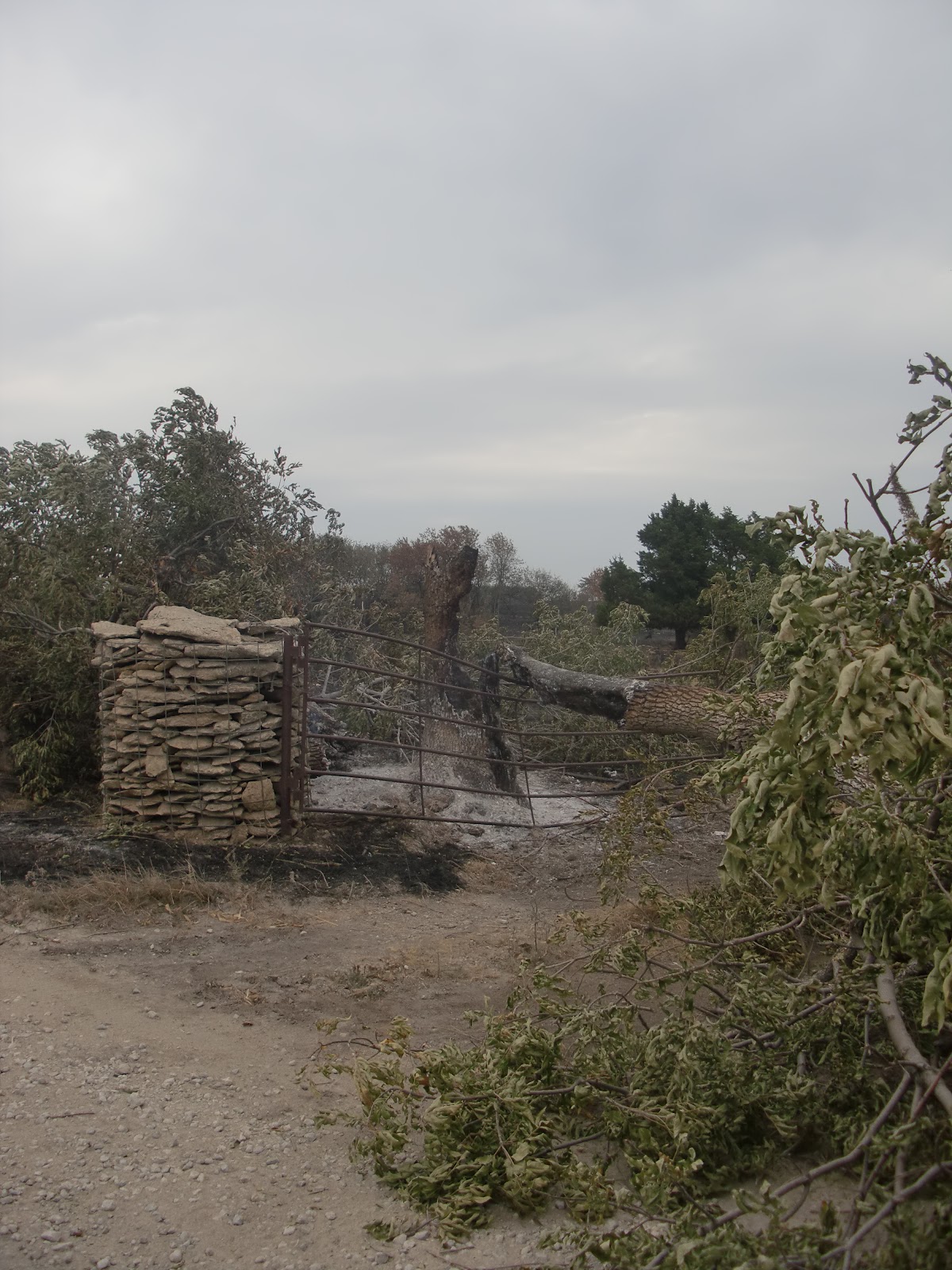
Here is what the pastures looked like before the fire.
 Stay safe everyone and have a great week!

-A Kansas Farm Mom